
How many moth species are there are in UK? Is it: (a) 130 (b) 259 or (c) 2500? (d) 4580? (There are 59 butterfly species). Answer at the end.
- rothburycan
- Jul 23
- 5 min read
Updated: Jul 27
On the morning of Tuesday 22nd July Rothbury CAN members and supporters were again treated to a most fascinating and informative workshop by the enthusiastic, incredibly knowledgeable, and entertaining, Mark Welfare.

Mark had kindly set his moth trap the night before, and brought it to Rothbury for us to see what had collected within it.

The moth trap. It is filled with cardboard egg trays, the moths, attracted to the light, fly into the trap, and settle within the egg spaces, above and below.


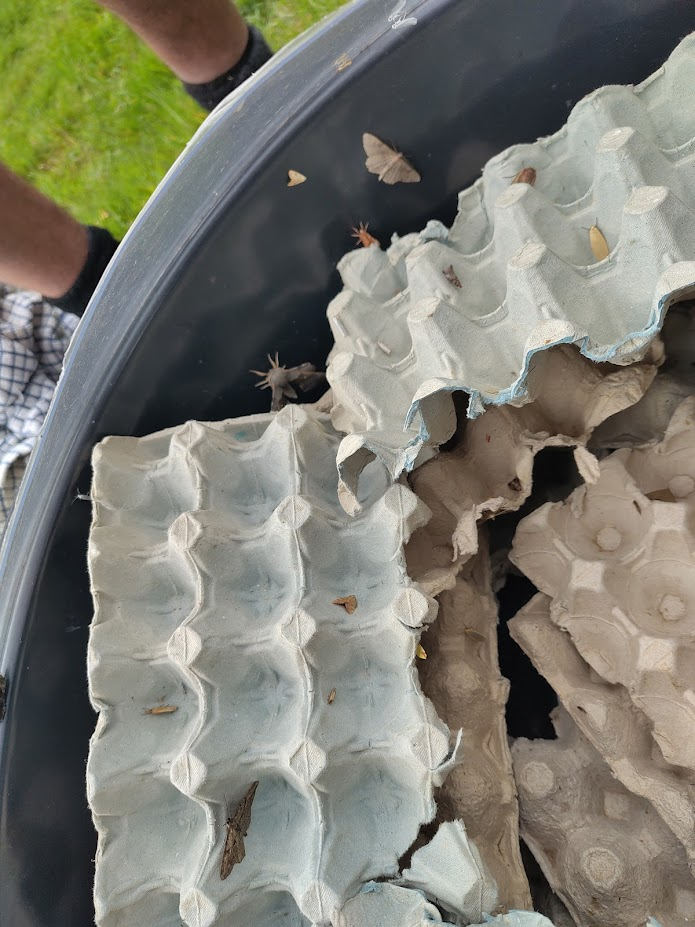


They were all fascinating to learn about, so many different kinds.
We were all engaged in hearing about the different features, habitats, habits, of all these many differing moths.
All caught on one night, in one garden, in Morpeth.

I really loved the names of the moths - they seem to mostly be named after their appearance, so we have, for example, Blue Bordered Carpet, Bright Wave, Dusky Hook-tip, Feathered Gothic, Lace Border, my favourite: Mother Shipton, actually named after Old Mother Shipton! - I could go on, but you will get my meaning!
Fabulous names.
What is a moth? What is a butterfly?
Moths and butterflies are insects which together form the order called Lepidoptera, meaning 'scaly-winged'. The patterns and colours of their wings are formed by thousands of tiny scales, overlapping like tiles on a roof.
Something that I found extremely eye-opening is that there is not really that much different between butterflies and moths. Mark explained that there is not really a straightforward answer when I asked him to tell us the difference.
We can find 'rules' such as on the Woodland Trust website, we learn that:
The one sure way to decide whether you’re looking at a butterfly or a moth is to look at its antennae. Butterfly antennae are usually very thin and topped by a ‘club’ – UK butterflies never have thick or feathery antennae. Moth antennae, on the other hand, don’t have this club and are usually thicker. Male moths of some species including the pale tussock, emperor moth and December moth have some truly impressive feathery antennae.
However, the WT goes one to say that 'There are exceptions to the rule'.
I answered my own question when I said 'I thought that butterflies always land with their wings closed, and moths, with their wings open?' Then I looked at the moth specimens on the table in front of us. All moths. All wings closed. Though we later saw some with wings open.


Myths about moths
There are lots of myths about moths that people use to separate them from butterflies, when in fact, they’re incredibly similar insects. Some even share the same name – like the swallowtail butterfly and swallow-tailed moth, or the brimstone butterfly and brimstone moth.
Here are some misconceptions about moths – and the surprising facts.
Moths are bigger than butterflies
Compared to the 60-or-so species of butterfly in the UK, we have around ( the number - wait till the end!) species of moth, and their diversity is staggering. Some of them certainly are bigger than butterflies – our largest resident moth, the privet hawk-moth, has a hulking great wingspan of up to 120mm, while our biggest butterfly, the swallowtail, has a wingspan up to 90mm.
We also have some very tiny moths, with our smallest measuring in at just 3mm. This is positively miniscule compared to our smallest butterfly, the small blue, which has a wingspan of around 30mm.
Indicators of Climate Change
Moths can live in very surprising places - such as sand dunes and marshlands. You can find them throughout the year, including (some species) in winter.
Studying butterflies and moths has become a main way to measure how rapidly climate change is occurring. This is because they quite quickly make changes to their habitats in response to environmental changes.
Mark explained that he has seen many moths that did not appear in Northumberland before, arrive in his garden, in Morpeth.
UK Butterfly Monitoring Scheme reports that:
Butterflies have short life cycles and thus react quickly to environmental changes. Their limited dispersal ability, larval foodplant specialisation and close-reliance on the weather and climate make many butterfly species sensitive to fine-scale changes. Recent research has shown that butterflies have declined more rapidly than birds and plants emphasising their potential role as indicators. Butterflies occur in all of the main terrestrial habitat types in the UK and so have the potential to act as indicators for a wide range of species and habitats. Unlike most other groups of insects, butterflies are well-documented, their taxonomy is understood, they are easy to recognise and we have a wealth of information on their ecology and life-histories.
Because insects make up the largest proportion of terrestrial wildlife (more than 50% of species), it is crucial that we assess the fate of insect groups in order to monitor the overall state of biodiversity. Being typical insects, the responses seen in butterflies are more likely to reflect changes amongst other insect groups, and thus the majority of biodiversity, than established indicators such as those based on birds.

So how many species of moth ARE there in the UK? Is it (a) 130 (b) 259 or (c) 2500? (d) 4580?
ANSWER: 2,500
Isn't that a great many!?
Hoverflies
After looking and learning about moths, we had a look around the beautiful garden we were in, in Rothbury, to see how many different types of hoverflies we could spot. We saw loads of different kinds of bee, including a cuckoo bee. Hoverflies were everywhere, and who knew there are so many different types?! 270 species have been recorded. ID Hoverflies


It was a wonderful morning, and we all learned such a lot. A massive thank you to Mark Welfare, who makes learning fun and entertaining. Thanks to Marjorie and Michael for the generous loan of her wonderful garden. And thanks to all the Rothbury CAN supporters and members, who came along to learn more about moths and hoverflies.
If you would like to join Rothbury CAN members and supporters on one of our fun events, take a look at the EVENTS page.

For those of you who would like to know the official names of the flying species we caught in the Rothbury Garden:
Hovers:
Melanostoma scalare
Platycheirus albimanus
Dasysyrphus tricinctus
Dasysyrphus albostriatus
Episyrphus balteatus - the marmalade hover
Epistrophe grossulariae
Eupeodes luniger
Leucozona lucorum
Leucozona glaucia
Meliscaeva cinctella
Syrphus sp
Rhingia campestris
Chrysogaster solstitialis
Eristalis pertinax
Helophilus pendulus
Myathropa florea
Volucella pellucens
Syrita pipiens
Xylota segnis
Plus the fly Dexiosoma canium
Bees:
Patchwork leafcutter
Buff tailed, white-tailed agg, garden, and tree bumblebees
Common carder bee
Several very worn cuckoo bumblebees – probably Bombus bohemicus, Gypsy or Bohemian cuckoo bee
True bugs:
Liocoris tripustulatus
Hairy shieldbug
Anthocoris nemorum


Comments